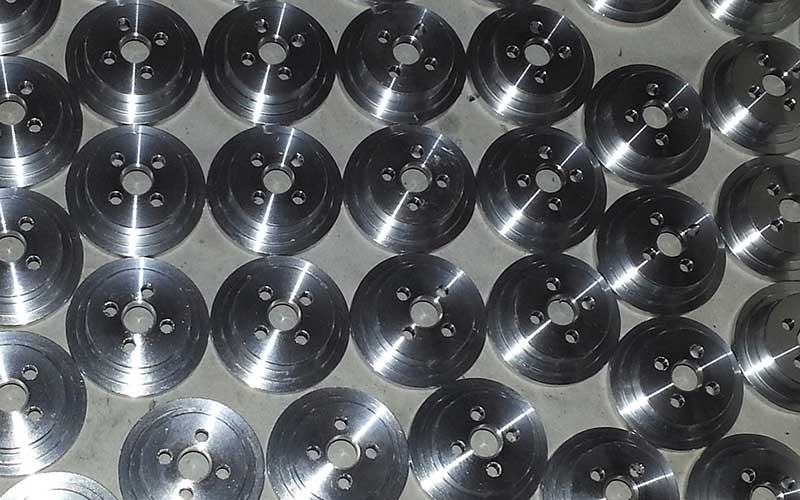
Anodising
The aesthetic quality and corrosion-resistance of aluminium can be increased considerably if a protection layer is formed on its surface by anodic oxidisation.
During electrochemical oxidation (anodising, anodisation or anodic oxidation), the products immersed in electrolytes of proper composition and concentration – usually acids – serve as anode. The oxygen generated on the anode reacts with the metal surface, creating an oxide-layer thicker, harder and chemically more resistant than a natural oxide-layer. This means that anodic oxidation forms a protection layer of the metal itself, as opposed to electroplating where the metal deposited from electrolyte settles on the surface of the product.
The anodic oxide layer made of aluminium or its alloys is used:
- as protection layer against chemical and mechanical effects,
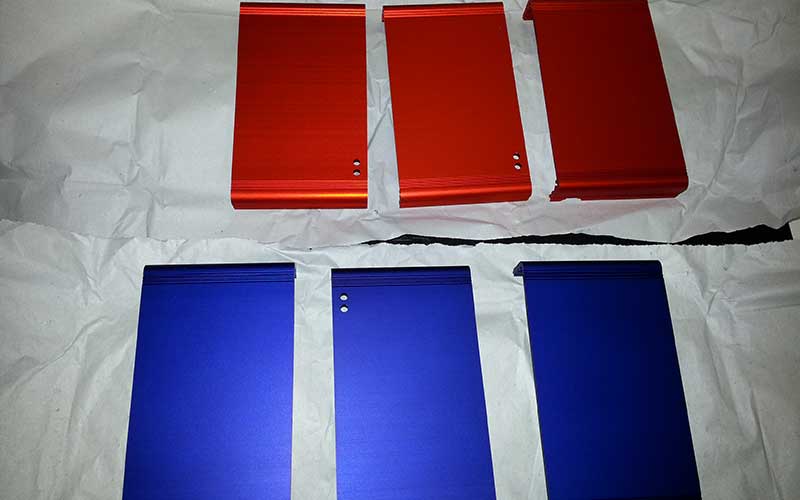
- as decorative layer, especially with colouration,
- as intermediate layer before electroplating or painting, for the manufacture of electrolytic capacitors,
- to form a hard wear-resistant layer, etc.
Formation of a colourless oxide layer
One of the most widely used processes is direct-current sulphuric-acid anodising (GS Process), in which an oxide layer with a thickness of 20 to 25 μm is produced in sulphuric acid of 20% concentration at 25 °C. This process can be carried out not only with direct current but also with alternating current (WS Process), but in this case the layer will get a yellowish shade. The oxide layer can be coloured well in both processes.
Both processes have the disadvantage that the thickness of the generated oxide layer is limited (up to ca. 35 μm) by conventional process parameters due to the oxide-solving effect of sulphuric acid.
The direct-current and alternating-current oxalic acid processes (GX Process and WX Process) are used where a thicker and more delicate oxide layer with good decorative and protecting properties is needed.
The sulphuric-acid oxalic-acid process (GSX Process) integrates the advantages of the above methods: here the oxide-solving capacity of the sulphuric acid solution is restricted by the addition of oxalic acid. The rate of oxide formation is increased by increasing the voltage.
The phosphoric-acid anodizing process usually produces a very thin and porous oxide layer. This special structure is generally not suitable for decorative and protection purposes, but it is very good for special technical purposes, e.g. it produces a base layer ensuring high bonding strength before electroplating.
In order to ensure corrosion-resistance, the anodised oxide layer is subjected to after-treatment, which usually means the operation of “sealing” in ion-exchanged water with special additives at a temperature of 95 to 100 °C.
Other types of after-treatment can also be applied, e.g. with special oils or lacquers.
Anodised products